Events
We believe that progress in HIV policy, research and care depends on collaboration and shared knowledge. Our events bring together policymakers, researchers, clinicians, patient advocates, and industry leaders to exchange insights, showcase evidence, and drive concrete action at the European level.
From high-level policy discussions to expert workshops, each event is designed to advance better long-term health outcomes and quality of life for people living with HIV. Explore our upcoming and past events to see how we are shaping the HIV policy agenda across Europe.
Past Events
*
Past Events *

Event highlights over the years
2025
10 December
HIV Outcomes at the European AIDS Conference
15-18 October
2021
HIV 40 years on: Time to focus now on health-related quality of life!
01 December
HRQoL lessons-learned from Covid-19 at IAS
20 July
Working Group on EU4Health funding opportunities for HIV projects
17 June
Roundtable on the HRQoL of people living with HIV in the UK
16 June
Workshop with UNAIDS: how to define HRQoL
24 February
Upcoming Events
*
Upcoming Events *

Building political momentum towards ending HIV in Europe

Building political momentum: Towards Ending HIV in Europe
World AIDS Day
Organised by MEP Frédérique Ries (Renew Europe Vice-President, Belgium), MEP Sara Cerdas (S&D, Portugal) and MEP Sirpa Pietikäinen (EPP, Finland), in collaboration with HIV Outcomes
With the participation of EU Health Commissioner Stella Kyriakides, EU Equity Commissioner Helena Dalli
While substantial progress has been made in the fight against HIV, Europe’s commitment to end HIV requires renewed political action and attention. As people living with HIV are living longer and healthier lives, the current landscape requires a more integrated, person-centred approach to address their complex needs. Acknowledging and addressing these multi-faceted challenges is crucial to upholding Europe’s commitment and delivering comprehensive care for people living with HIV.
The event focused on driving meaningful political change and strengthening HIV policies in the context of the 2024 elections in the European Parliament and the new European Commission configuration. It particularly reflected on policy actions that can help advancing towards the shared goal of ending HIV in Europe, while emphasising the importance of sustained action and addressing the evolving needs of people living with HIV.
Key takeaways
EU Health Commissioner Stella Kyriakides welcomed the work of HIV Outcomes towards making this event possible and reminded that, thanks to great medical progress, HIV is now seen as a chronic condition. However, progress remains to be done and HIV remains a global public health challenge – at both EU and global levels – and that further considerable investments are needed to address stigma and improve equity and long-term care as part of a stronger Health Union, notably for populations most at risk. Commissioner Kyriakides also emphasised the importance of HIV remaining a priority in 2024, despite the elections of the European Parliament and the nomination of the new European Commission, towards achieving UNAIDS targets to end the HIV pandemic in 2030.
EU Equality Commissioner Helena Dalli stressed the importance to fight stigma, notably in healthcare settings, further alienating vulnerable populations who need HIV care, and the need to improve education and awareness in that regard.
UNAIDS Executive Director for Policy, Advocacy and the Knowledge Branch Christine Stegling, highlighted the role of communities to reach the 2030 targets and applauded those 3 countries already achieved them, with 16 others close to this objective. She reminded the multisectorality of addressing HIV globally and called for comprehensive approaches to ensure no one is left behind in prevention strategies (e.g., adolescent girls, young women).
EATG’s Magdalena Bartnik focused on the crucial role communities, governments and other institutions should have, supporting non-judgmental efforts to develop and implement drug prevention policies for all populations, while reminding the need for governments’ accountability in that regard. Professor Oana Sandulescu stressed the importance of using Patient Reported Outcomes (PROs) in healthcare settings and the need to streamline their measurement and assessment at European level. Dr Nicoletta Policek reflected on people with HIV living longer and longer, but simultaneously suffering more from comorbidities. Addressing this notably requires strongly integrated care adapted to national / regional systems, initiatives against stigma and communities’ involvement focusing also on social root issues.
-
MEP Frédérique Ries, Renew Europe Vice-President, Belgium
EU Health Commissioner Stella Kyriakides
EU Equality Commissioner Helena Dalli (pre-recorded video message on stigma)
Christine Stegling, UNAIDS Deputy Executive Director, Policy, Advocacy and Knowledge Branch
Magdalena Bartnik, European AIDS Treatment Group member, and Executive Director of the Prekursor Foundation for Social Policy, Poland
Prof Oana Sandulescu, Carol Davila University of Medicine and Pharmacy, National Institute for Infectious Diseases "Prof. Dr. Matei Bals", Bucharest, Romania
Mario Cascio, Chair Quality of Life Programme at European AIDS Treatment Group, HIV Outcomes Steering Group member
Prof Jeffrey Lazarus, HIV Outcomes Co-Chair, Head of Health Systems Research Group ISGlobal at Hospital Clinic, University of Barcelona, Spain
Prof Nicoletta Policek, UK CAB Chairperson
MEP Sara Cerdas, S&D, Portugal
MEP Sirpa Pietikäinen, EPP, Finland
-
13:00-13:10 | Speakers and guests arrival
13:10-13:15 | Opening remarks
Jacki Davis, Moderator13:15-13:25 | Keynote speeches – EU commitment to ending HIV: Fostering equality and eliminating stigma
EU Health Commissioner Stella Kyriakides
EU Equality Commissioner Helena Dalli (pre-recorded video message)
13:25-13:30 | Shedding light on inequalities in ending HIV in Europe
Christine Stegling, UNAIDS Deputy Executive Director, Policy, Advocacy and Knowledge Branch13:30-13:40 | Accelerating HIV prevention for achieving the elimination targets
Magdalena Bartnik, European AIDS Treatment Group member, and Executive Director of the Prekursor Foundation for Social Policy, Poland13:40-14:40 | Advancing HIV Care: A person-centred approach to long-term health and the HRQoL among people living with HIV
Improving the HRQoL of people with HIV: addressing structural stigma and discrimination, as well as mental health
Prof Oana Sandulescu, Carol Davila University of Medicine and Pharmacy, National Institute for Infectious Diseases "Prof. Dr. Matei Bals", Bucharest, RomaniaComorbidity prevention, treatment, and management
Mario Cascio, Chair Quality of Life Programme at European AIDS Treatment Group, HIV Outcomes Steering Group memberMeasurement and monitoring of the health-related quality of life of people living with HIV
Prof Jeffrey Lazarus, HIV Outcomes Co-Chair, Head of Health Systems Research Group ISGlobal at Hospital Clinic, University of Barcelona, SpainEnsuring healthy ageing for people living with HIV
Dr Nicoletta Policek, UK CAB Chairperson, HIV Outcomes UKDiscussion and Q&A
14:40-14:45 | Call for Action: Towards Ending HIV in Europe
MEP Sara Cerdas, S&D, Portugal14:45-14:50 | Closing remarks and next steps
MEP Sirpa Pietikäinen, EPP, Finland


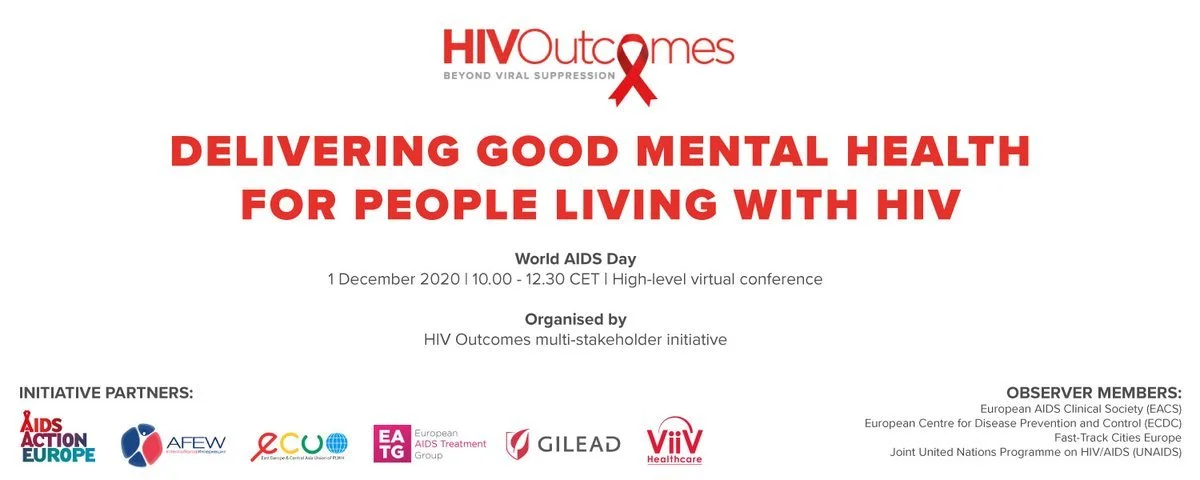
Delivering good mental health for people living with HIV
Integrating mental health services into HIV care is essential to improve overall well-being for people living with HIV
People living with HIV are more likely than average to develop mental health issues, but this is not yet fully reflected in HIV services, policies or practices. Stigma, discrimination and social isolation can add to the burden of anxiety and depression facing the HIV community.
However, integrating psychosocial supports into hospital and community-based care remains a major challenge across Europe and beyond. Clear reimbursement and referral pathways, along with better use of digital health tools and data insights, can help to ensure services meet the needs of the HIV community.
These were among the recurring themes at a high-level online conference convened by HIV Outcomes to mark World AIDS Day 2020. The event focused on mental health – a topic in line with the wider goal of shifting the focus of HIV policy beyond viral suppression.
-
Stella Kyriakides, European Commissioner for Health and Food Safety
Dr Hans Kluge, WHO Europe Director
Vinay P. Saldanha, Special Adviser to Executive Director UNAIDS
Ortwin Schulte, representative of the German EU Presidency
Frédérique Ries, Renew Europe, Belgium
Dr Cristian Buşoi(, European People’s Party, Romania
Sara Cerdas. Socialists & Democrats, Portugal
Tilly Metz, Greens/European Free Alliance, Luxembourg
-
10:00 | Welcome remarks
MEP Frédérique Ries, Renew Europe, Belgium
Dr Jeffrey Lazarus, Co-Chair, HIV Outcomes
10:10 | Setting the scene: Mental health and living with HIV: perspectives of a person living with HIV and a clinician
Marian Said, Member, European AIDS Treatment Group (EATG)
Dr Joop Arends, Infectious Diseases Physician and Happi app Founder
10:25 | Rethinking European health systems to improve the quality of life of people living with HIV
Stella Kyriakides, European Commissioner for Health and Food Safety
10:35 | panel discussion
11:05 | Q&A
Integrating mental health into HIV care
MEP Sara Cerdas, Progressive Alliance of Socialists and Democrats (S&D), Portugal
Leoluca Orlando, City Mayor of Palermo, representing Fast-Track Cities Europe, Italy
Ortwin Schulte, Head of Health Unit, Permanent Representation of Germany to the EU
Hilkka Kärkkäinen, President, Global Alliance of Mental Illness Advocacy Networks (GAMIAN)
11: 15 | BREAK
11:25 | Sharing of best practices in mental health support for people living with HIV
Ana-Maria Schweitzer, Executive Director, Baylor Foundation, Romania
11:35 | Stronger healthcare systems to leave no one behind
Dr Hans Kluge, Director, WHO Europe
11:40 | panel discussion
12:05 | Q&A
Cooperating internationally to address the mental health needs of people living with HIV
MEP Tilly Metz, Greens/European Free Alliance, Luxembourg
Dr Nicole Simone Seguy, Unit lead HIV and hepatitis, WHO Europe
Vinay Saldanha, Special Adviser to Executive Director Winnie Byanyima, UNAIDS
Igor Gordon, Programme Director, Eurasian Harm Reduction Association (EHRA)
12:15 | Closing remarks and next steps
John Bowis, Co-President, HIV Outcomes
MEP Cristian Bușoi, European People's Party (EPP), Romania
Nikos Dedes, Co-Chair, HIV Outcomes
Our partners




Observer Members


Strategic Partner