
The Journey from Evidence to Practice
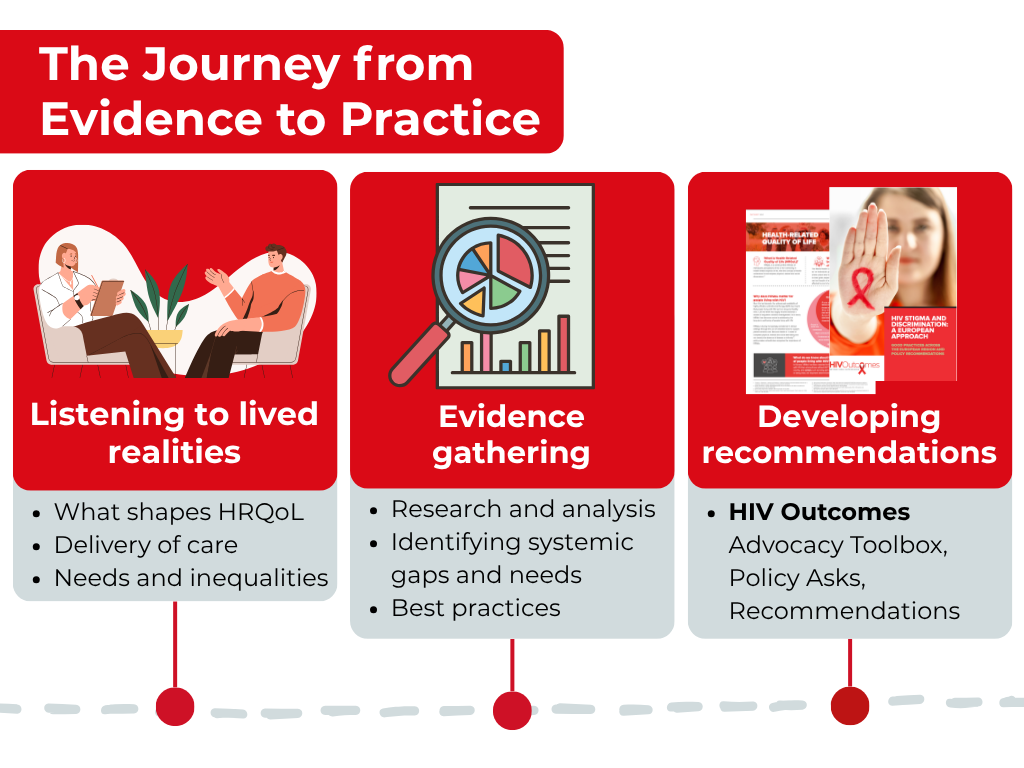
For people living with HIV, evidence only matters if it leads to change.
Over the past decade, HIV Outcomes has focused on turning the insights and experiences of people living with HIV into concrete actions that improve how care is designed, delivered and evaluated across Europe.
The journey begins by listening closely to lived realities: how people live with HIV, what shapes their health‑related quality of life (HRQoL), how care is delivered, and where health systems still fall short.
These insights are then gathered and analysed to generate a robust evidence-based picture revealing inequalities and highlighting where action is most urgently needed. From there, evidence is translated into clear, policy‑ready recommendations that can be taken forward by EU institutions, national authorities and healthcare providers alike, including at clinic level.
Through sustained engagement with relevant institutions, HIV Outcomes supports the integration of these recommendations into standards, strategies and policy frameworks, with one clear objective: delivering measurable improvements in care and HRQoL for people living with HIV.
Over the years, this approach has led to a series of practical tools. Firstly, our Advocacy Toolbox and Policy Ask equip stakeholders with clear problem statements, robust evidence, and policy-ready messages and arguments to support engagement with decision-makers. In parallel, HIV Outcomes’ ever-growing Good Practices Compendium serves as a living catalogue showing how HIV care and HRQoL can be improved across settings. It showcases practices on integrated care, mental health, stigma and discrimination, education, advocacy and research, many of which can be adapted and replicated across countries. Particularly, practices related to HIV stigma and discriminationhave also been included in a dedicated report, offering a series of recommendations to fight stigma and discrimination at EU level.
Together, these resources illustrate a core principle of HIV Outcomes’ work: evidence creates value when it is structured, comparable and leveraged to inform decisions.
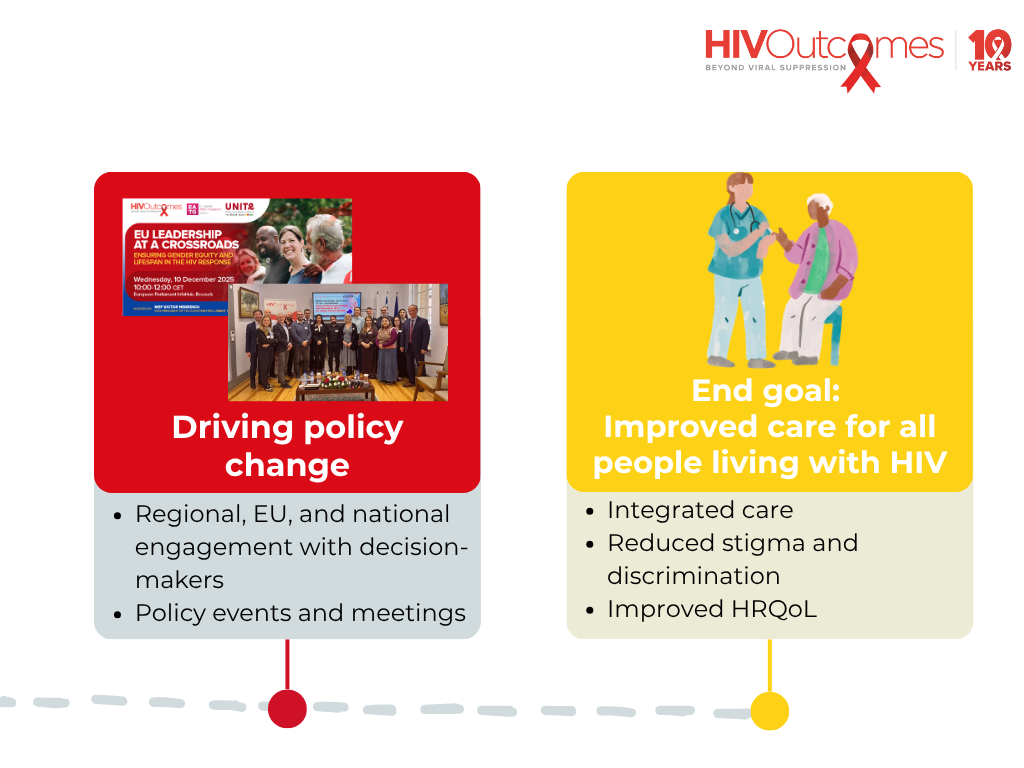
This principle is increasingly relevant in today’s EU policy landscape. HIV Outcomes has consistently advocated for stronger EU‑level coordination, clearer standards and better use of existing data to support evidence‑based public health action. A long‑standing policy ask has been the systematic measurement of patient‑reported outcomes (PROMs) and HRQoL monitoring, ensuring that policies are informed not only by clinical indicators, but also by the lived experiences of people living with HIV.
Looking ahead, this approach must be embedded in a future EU Action Plan on HIV/AIDS, grounded in robust, actionable and comparable evidence.
What can you do?
Do you have a good practice on how evidence-driven approaches are improving HIV care? Be ready to submit it when the call for Good Practices reopens in August!
In the meantime, you can already take action:
Review existing good practices and identify elements that could be adapted to your own setting (e.g. use of PROMs, integrated, multidisciplinary care models, psychosocial support services).
Pilot small changes in your daily work, such as integrating PROMs into consultations or strengthening how data is used to inform care decisions.
Engage your teams and partners to explore how these approaches could be adapted or scaled locally.
Only through concrete implementation and shared learning can we advance more person-centred, evidence-based HIV care across Europe
What’s next?
Looking ahead, HIV Outcomes continues our mission to turn evidence into practice.
A dedicated Patient-Reported Outcome Measures (PROMs) toolkit will be launched soon, supporting healthcare providers, policymakers, and other stakeholders to better understand what PROMs are, their benefits, and how they can be implemented in clinical practice to facilitate person-centred HIV care.
In September, the Good Practices Compendium will reopen for submissions, creating a new opportunity for stakeholders across Europe to contribute examples of how evidence is being used to drive meaningful change in HIV care.