
10 Years of Impact: A roadmap of how HIV Outcomes moved the needle
Ten years ago, HIV policy in Europe was guided by one overriding metric: viral suppression. The UNAIDS 90-90-90 targets were pivotal in transforming testing, treatment access and clinical outcomes. But that success came with a blind spot. Once viral suppression was achieved, the lived realities of people living and ageing with HIV – navigating comorbidities, mental and social health, stigma and discrimination, to name a few – too often fell outside the scope of policy discussions.
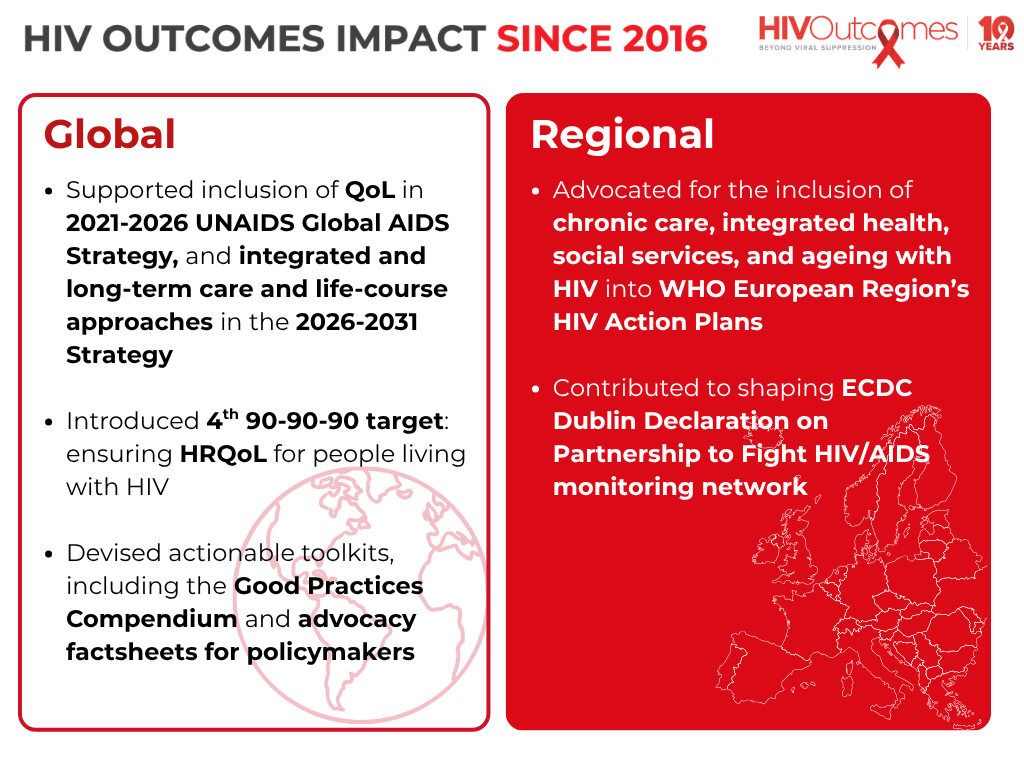
HIV Outcomes was created to challenge that narrow endpoint. From the outset, the initiative challenged the idea that viral suppression marked the “end point” of HIV care. Instead, it argued that long-term health and wellbeing must be recognised as core outcomes in their own right. This vision crystallised in the call for a fourth 90 ten years ago: ensuring that people living with HIV who are virally suppressed also enjoy good health-related quality of life (HRQoL).
This shift reframed policy thinking, moving away from purely biomedical indicators. HRQoL, shaped by physical and mental health, treatment burden, ageing, stigma, discrimination and social wellbeing, offered a more realistic, person-centred understanding of what it truly means to live well with HIV.
A decade of driving Global, Regional, and National change
HIV Outcomes’ advocacy supported the inclusion of quality of life (QoL) in the 2021–2026 UNAIDS Global AIDS Strategy, which shifted the global targets from 90-90-90 to 95-95-95 and introduced dedicated targets on stigma and discrimination. HIV Outcomes also contributed to the 2026-2031 UNAIDS Global AIDS Strategy, which now calls for strengthening long-term, integrated care, better integration with social services, and addressing the needs of people ageing with HIV.
Across the WHO European Region, action plans for ending HIV 2022-2030 have increasingly embraced chronic care, integrated health and social services, and ageing with HIV as policy priorities, helping to shift regional discourse from short-term outcomes to lifelong wellbeing. HIV Outcomes has also contributed to shaping the ECDC Dublin Declaration on Partnership to Fight HIV/AIDS monitoring framework; we now continue advocating to leverage the Irish presidency to renew commitment towards HIV through a revised version of the Declaration.
The HIV Outcomes national initiatives in UK, Romania, and Italy have demonstrated how national policy environments can be reformed to embed HRQoL. They have supported the integration of HRQoL as an equal outcome in decision-making, from shaping national action plans and social policies to securing recognition of ageing and chronic care within therapeutic care pathways. More about the past and future work of the national initiatives will be included in an upcoming story – stay tuned!
Turning concepts into political action in the EU
At the EU level, HIV Outcomes has worked to reposition HIV on the political agenda as a long-term public health priority. Through ongoing engagement with the EU institutions and policymakers:
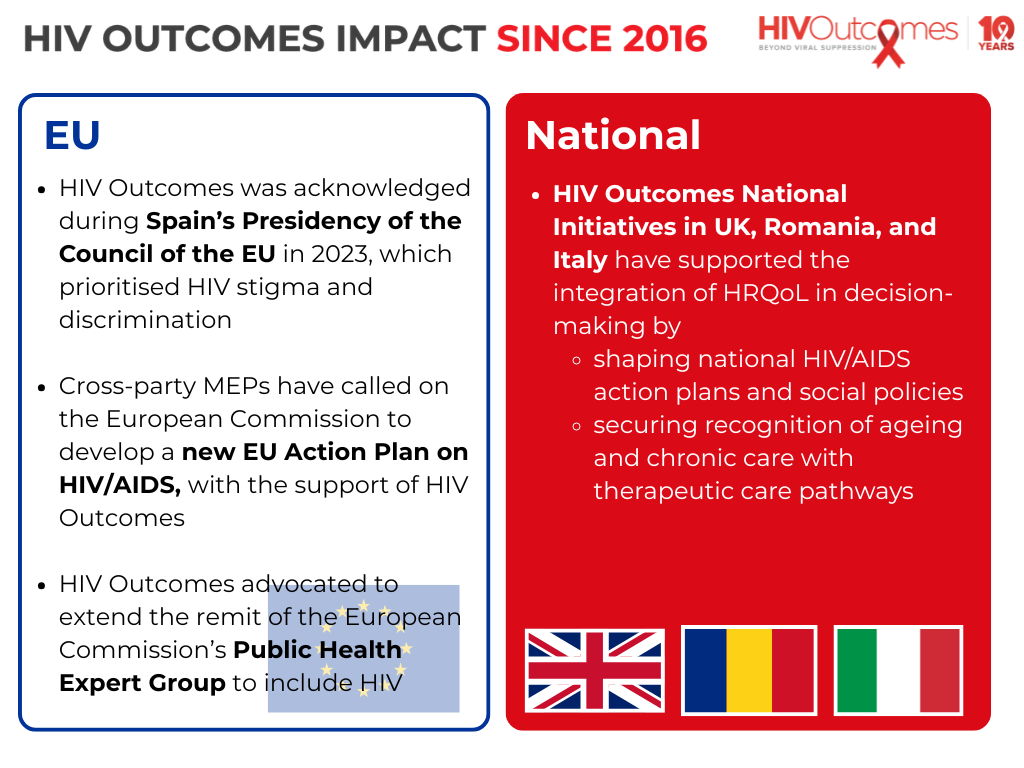
The Commission’s Public Health Expert Group expanded its remit to include communicable diseases, including HIV, and featured in previous EU4Health Annual Work Programmes.
HIV Outcomes has worked to ensure that EU health policies address the full realities of living with HIV, elevating issues like mental health, healthy ageing, stigma and discrimination, data privacy and equality into mainstream political debate.
During Spain’s Presidency of the Council of the EU in 2023, HIV stigma and discrimination were highlighted as priorities, with HIV Outcomes’ work acknowledged. HIV was also raised at an EU health ministers’ meeting, with support expressed by Romania, Spain and Poland.
The European Parliament has recognised HIV as a policy priority, triggering an ECDC study on the HRQoL of people living with HIV.
Cross‑party MEPs have mobilized to call on the European Commission to develop a new EU Action Plan on HIV/AIDS, supported by HIV Outcomes’ dedicated video campaign, and a question for written answer.
Turning advocacy into actionable tools
Over time, HIV Outcomes has contributed not only with targeted advocacy efforts, engaging with key stakeholders in the global, European, and EU spheres, but also with the development of practical, actionable materials, including:
The Good Practices Compendium, complementing the WHO compendium by showcasing examples of chronic care models that improve health and wellbeing for people living with HIV.
The Lancet HIV Series Beyond Viral Suppression, highlighting how current health systems remain unprepared to meet the needs of people ageing with HIV.
Advocacy factsheets to help policymakers and health advocates understand and apply HRQoL in policy and practice.
Our Call to Action for a new EU Action Plan on HIV/AIDS, setting out the key EU-level steps required to help meet the UN target of ending the HIV epidemic by 2030.
A decade of progress — and the road ahead
For ten years, HIV Outcomes has helped shift the narrative from surviving with HIV to living well with HIV. The challenge now is to ensure that this shift is fully implemented, that goodHRQoL becomes the benchmark against which Europe measures success.
A renewed EU Action Plan on HIV/AIDS is a critical opportunity to bring this vision to life, align health and social policies, and ensure healthy ageing and long-term wellbeing sit at the heart of Europe’s HIV response. A revision of the 2024 Dublin Declaration is also in order, to ensure that it reflects the realities and needs of people living with HIV.
What can you do?
As EU institutions, Member States, policymakers, clinicians, community representatives, and researchers, you all have a role in advancing HRQoL, reducing stigma, and ensuring long-term, person-centred care. Use your voice and your platforms to reinforce the need for an EU HIV/AIDS Action Plan that puts quality of life, ageing and long-term care at the center, and for a revised Dublin Declaration that reflects real life experiences.
What is next?
HIV Outcomes will continue advocating for renewed EU leadership on HIV/AIDS, centred on HRQoL, ageing and integrated care. By the end of 2026, the updated HIV Outcomes Policy Asks will be published, reflecting the latest needs and priorities across Europe.
Two more advocacy toolkits, one focused on the use of Patient-Reported Outcome Measures and the other on people living with HIV in vulnerable situations, will also be published in 2026 – stay tuned to learn more!